
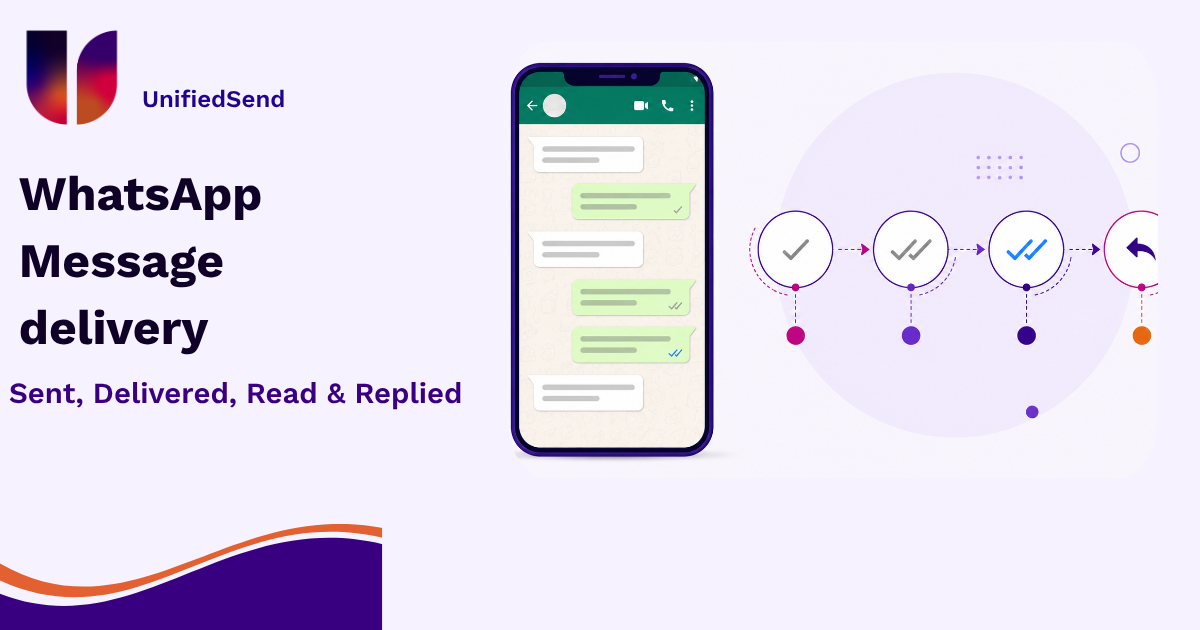
WhatsApp message sending looks simple until you try to operate it properly.
You make an API call. You get a success response. The provider gives you a message ID. Everyone relaxes.
That is usually where the real problems begin.
If your system treats accepted as done, you will eventually lie to your own dashboards, confuse support, misfire follow-up automation, and make tenant-level delivery issues much harder to diagnose. The API is the easy part. The messy part is what happens after the platform says, “request received.”
The acceptance response is an acknowledgement, not an outcome
When the WhatsApp API accepts a message request, it is confirming that the request made it into the pipeline. That is useful, but it is not the same as proving the message was delivered, read, or even ultimately viable.
At that point, you usually know a few things:
- your request was valid enough to be accepted
- the platform generated or returned a provider-side message identifier
- processing can continue asynchronously
What you do not know yet is what your business usually cares about:
- did the message actually leave the provider pipeline
- did it reach the recipient device
- did it fail later because of policy, session, quality, or account state
- did your webhook processor even record the final state correctly
This distinction matters because product teams often model “send message” as a synchronous action. In production, it is an event stream.
Where teams usually break
Most teams do not fail because they cannot send messages. They fail because they do not model the states around sending.
Common failure modes look like this:
- False success: the API returned 200, so the application marks the message as sent even though final delivery never happened.
- Broken automation: downstream flows trigger from acceptance rather than delivery or a more meaningful business event.
- Support ambiguity: internal users see “sent” in the UI, while the customer never received anything.
- Missing correlation: webhook events arrive later, duplicated, or out of order, and there is no reliable way to reconcile them with the original request.
- Tenant bleed: one tenant’s number health or template problems pollute shared queues, logs, or alerting.
None of this is exotic. This is normal messaging infrastructure behavior.
You need an event ledger, not a single status field
A single status column is fine for demos. It is not enough for a real messaging system.
At minimum, each outbound message should have a durable record of:
- your internal message ID
- tenant ID and sending number or sender identity
- template or content metadata used at send time
- the provider request payload you consider canonical
- the synchronous API response
- the provider message ID
- every webhook state transition you receive after that
- timestamps for each transition
- any retry, dead-letter, or manual intervention events
That model gives you a proper event ledger instead of a fragile snapshot.
Why does that matter? Because messaging systems are asynchronous, eventually consistent, and occasionally annoying. If you only store the latest state, you lose the chain of custody. When something goes wrong, you no longer know whether the failure happened at request validation, provider processing, webhook ingestion, or your own state machine.
Design for duplicated, delayed, and missing webhooks
Webhook delivery is where a lot of clean-looking architectures become fiction.
In practice, webhook events can be:
- duplicated
- delayed
- received out of order
- temporarily missing because your endpoint was unavailable
- processed twice because your own workers retried badly
So the correct design is usually:
- make webhook ingestion idempotent
- store raw events before transforming them
- separate ingest from downstream business processing
- rebuild current state from ordered events or deterministic reconciliation rules
- alert on stalled state transitions instead of assuming everything completed
If that sounds more like payments infrastructure than a chat feature, that is the point. Messaging at scale behaves like infrastructure.
Acceptance is not the right trigger for most business logic
A subtle but expensive mistake is using API acceptance as the trigger for business workflows.
For example:
- marking a notification as completed the moment the request is accepted
- starting a follow-up countdown before delivery is confirmed
- telling an internal user “the customer has been notified” too early
- billing immediately on request submission instead of on the event your billing model actually depends on
The right trigger depends on the workflow. Sometimes acceptance is enough. Often it is not. The important part is to make that choice deliberately instead of letting the transport response leak into product logic by default.
Multi-tenant systems make this sharper
In a multi-tenant platform, weak message state modeling creates operational debt fast.
You need to be able to answer questions like:
- which tenant owns this message and webhook event
- which number, WABA, or sender configuration was used
- whether a spike in failures is isolated or systemic
- whether retries should happen globally, per tenant, or not at all
- which support team should see which failure details
Once multiple businesses share the same transport layer, “sent” stops being a useful operational answer. You need scoped observability, not hopeful summaries.
Build-vs-buy is really about operational tolerance
This is where the build-vs-buy conversation usually gets more honest.
The question is not just whether your team can call the API. Of course it can. The question is whether you want to own:
- state reconciliation
- provider abstraction drift
- webhook durability
- compliance edge cases
- tenant-safe observability
- support tooling for disputed delivery states
Most abstractions do not remove complexity. They relocate it. If you build your own messaging layer, you are choosing where that relocated complexity lives and who gets paged when it goes wrong.
A better default model
If you are designing a serious WhatsApp messaging system, a better default is:
- treat the send API response as an acknowledgement event
- persist the provider message ID immediately
- ingest all status webhooks into a durable event log
- derive current message state from explicit reconciliation rules
- trigger business workflows from the state that actually matters
- keep tenant boundaries explicit in every part of the pipeline
That model is not flashy, but it survives contact with reality.
Final thought
The dangerous part of messaging infrastructure is that it can appear to work while still being poorly modeled.
A system that shows green because the request was accepted is not necessarily reliable. It may just be optimistic.
WhatsApp accepted your message. Good. Now do the part that actually makes the system trustworthy.
Next Step
Make WhatsApp work better for your business
Unified Send helps businesses manage campaigns, send messages, and follow
up with customers from one easy workspace.
Leave a Reply